Teaching, leading, and showing up
Rabbinic work takes many forms: building a curriculum with educators, opening a difficult text, leading a room in prayer, accompanying a family, or helping a learner discover that Jewish life has a place for their questions. Across those settings, I try to lead with attention, collaboration, and intellectual honesty.
As Assistant Director of KESHER at Larchmont Temple, I work with the Director of KESHER and Lifelong Learning, clergy, staff, educators, learners, and families to help shape the congregation's educational vision and support the daily life of its K–7 program.
One focus of that work is continuity. A spiral curriculum should do more than revisit familiar topics: it should help learners recognize how their understanding of Torah, prayer, ethics, identity, and community becomes more complex as they grow. That requires clear goals, strong collaboration with educators, and attention to what families and learners actually experience from year to year.
My work includes helping redesign the K–7 spiral curriculum, mentoring educators, supporting program operations, and planning worship, family learning, and congregation-wide experiences. Before moving into this role, I served Larchmont Temple as Music & Education Specialist, teaching Jewish studies, leading tefillah, working with children's choirs, participating in worship, and helping create Purim shpiels.
Curriculum development and grade-to-grade continuity. Educator mentoring and collaboration. Family and multigenerational learning. Tefillah, Hebrew, and Jewish studies. Program development and daily educational operations. Partnership with clergy, staff, families, and learners.
Work in progress:
Strengthening a K–7 spiral curriculum
Context: KESHER is Larchmont Temple's educational program for children and families.
Challenge: Create stronger continuity from grade to grade so that learning develops rather than resets each year.
Role: Partner in curriculum redesign, educator support, and program implementation.
Collaborators: Director of KESHER and Lifelong Learning, clergy, professional staff, educators, learners, and families.
Approach: Clarify the ideas and practices that should deepen over time; connect classroom learning to worship, family programs, holidays, and congregational life; support educators in making the framework usable with real learners.
Reflection: A curriculum is only as strong as the relationships and teaching practices that carry it. The framework matters, but so do the educators who interpret it and the learners who make it their own.
Making room for the question
I have taught children, teenagers, adults, families, and educators in congregations, camps, and classrooms. The setting changes, but the work begins the same way: find the question that makes the source matter and give learners enough structure to engage it directly.
I am drawn to teaching that crosses boundaries between text and experience. A lesson about the Temple incense can become a conversation about material culture, memory, community, scent, science, and the inclusion of what seems unpleasant. A biblical narrative can be studied through rabbinic commentary, visual art, music, or the ethical problem a learner notices first.
The goal is not novelty for its own sake. Creative methods are useful when they bring people closer to the text, make an argument visible, or allow more learners to participate responsibly.
Learning that connects
VisualMidrash
VisualMidrash grew from my interest in what happens when Jewish interpretation moves into a visual form. Classical midrash notices gaps, contradictions, echoes, and difficult silences in a text. VisualMidrash asks how an image can make an interpretive claim and how looking closely can become a mode of study.
Presence before answers
That formation continues to shape how I approach congregational life. A rabbi may bring ritual, text, music, or practical support, but first has to be willing to meet a person where they are.
I have played guitar and led Jewish music for more than twenty years. My work has included Shabbat and holiday worship, Tot Shabbat, family tefillah, children's choirs, congregational programs, camps, and classrooms.
Music can change how a community inhabits a prayer. It can create energy, but it can also create stillness. It can help someone who does not yet know the words participate, allow a familiar text to be heard differently, or turn a group of individuals into a congregation for a few shared minutes.
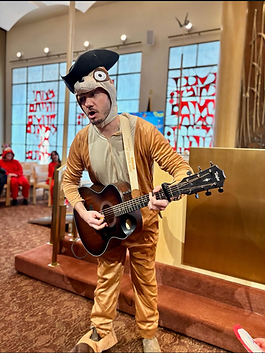
Helping a room participate
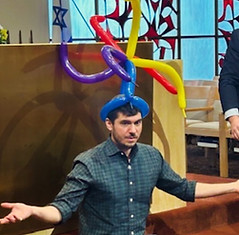
I approach music as part of rabbinic and educational leadership. Not as entertainment placed beside it. The musical choice should serve the prayer, the learners, and the moment. For so many of us, music is our first experience of the transcendent. It certainly was mine. I try to cultivate those moments through my music and worship leading.
Text that meets the world honestly
My sermons and teaching often begin where a source resists a simple answer: the Torah's cities of refuge, the silence of Aaron after the death of his sons, the emptiness of Joseph's pit, or the strange possibility that humor can keep a tradition honest.
I am interested in what Jewish texts ask of us when certainty is unavailable. That does not mean every interpretation is equally responsible. It means reading closely enough to notice the tension, listening to the arguments that came before us, and being willing to say what the text makes difficult.
Humor also belongs in that work. At its best, it does not reduce the stakes. It can interrupt self-importance, expose a false certainty, and give a community enough breathing room to remain inside an unresolved question.
Invite the work into your community
For teaching, scholar-in-residence programs, worship and music, curriculum conversations, VisualMidrash workshops, or rabbinic opportunities, please get in touch.