Rabbi, educator, and songleader
I am a Reform rabbi, Jewish educator, and songleader who brings text, art, music, and lived experience into conversation. Whether teaching Torah, shaping curriculum, leading worship, accompanying a family, or developing VisualMidrash, I want Jewish learning to be intellectually honest, emotionally present, and open to participation.

A life shaped by Jewish learning
I grew up in Ridgewood, New Jersey, and found an early Jewish home through Barnert Temple, NFTY, and the URJ camp system. Music was one of my first ways into Jewish practice: the experience of singing with other people made prayer feel less like something to observe and more like something a community could build together.
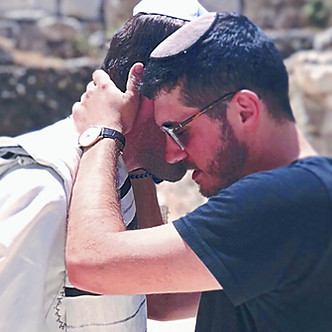
At Clark University, I studied Jewish Antiquity. After college, I lived in Israel and served in the Nahal Brigade of the Israel Defense Forces from 2012 to 2014. Those years remain part of how I think about Jewish peoplehood, responsibility, history, and the complexity of caring for Israel without reducing it to a symbol.
I later completed the Experiential Educators Program at the Pardes Institute of Jewish Studies and earned a Master of Arts in Religious Education from Hebrew Union College–Jewish Institute of Religion. HUC-JIR ordained me as a rabbi in 2024.
I also make art, though I think of it less as a separate practice than as another way of studying. Working from sofrut, Jewish mysticism, sacred text, and the early history of Jewish amulets and scribal tradition, I ask what happens when Hebrew letters stop describing the world and begin to take part in it: when a Divine Name grows from the center of a flower, or the word for “holy” has to be searched for before it can be read. Making these pieces is, for me, a form of study and a form of listening: I follow the shapes of the letters and the resistance of the materials until they show me something I did not plan.

Leading education in community
I serve as Assistant Director of KESHER at Larchmont Temple. Working with the Director of KESHER and Lifelong Learning, clergy, staff, educators, learners, and families, I help shape the congregation's vision for Jewish education and the daily life of its K–7 program.
My current work includes helping redesign a spiral curriculum, mentoring educators, supporting program operations, and planning worship, family learning, and congregation-wide experiences. I previously served Larchmont Temple as Music & Education Specialist, teaching Jewish studies, leading tefillah, working with children's choirs, participating in Shabbat and festival worship, and helping create the congregation's Purim shpiels.
Songleading, music, and worship
I am a musical rabbi and songleader. I have played guitar and led Jewish music for more than twenty years. Music shapes the way I teach, lead prayer, and build community; I do not think of it as a separate performance track. A melody can help a group enter a prayer, remember a text, take a risk together, or feel that it has a place in the room.

My work has included Tot Shabbat, family tefillah, Shabbat and holiday worship, children's choirs, camps, classrooms, and congregational programs. The goal is not simply to make a service more energetic. It is to help people participate with attention and find a form of prayer that feels both communal and real.
Learning through relationship
My approach to Jewish education begins with a simple premise: people do not enter a text, a prayer, or a community from the same place. Good teaching makes room for that difference without lowering the stakes of the learning.
I want learners to encounter the sources themselves; to notice a difficult word, question an inherited interpretation, test an idea with another person, and understand that disagreement can be part of responsible Jewish reading. The educator's task is not to make every tension disappear. It is to build enough trust, structure, and curiosity for people to remain in the conversation.
This is also why I care about continuity across a curriculum. A year of Jewish learning should not feel sealed off from the year before it or the rest of congregational life. Learners and families should be able to recognize the questions, practices, and relationships that deepen as they grow.
Pastoral formation
Before ordination, I completed three units of Clinical Pastoral Education at NYU Langone Health and provided spiritual care in more than 1,500 encounters with patients and families facing illness, grief, trauma, and end-of-life decisions.
Hospital chaplaincy changed the way I understand rabbinic presence. It taught me to listen before interpreting, to work with people across backgrounds and beliefs, and to resist the impulse to fill every silence. Sometimes care takes the form of prayer or ritual. Sometimes it is a conversation. Sometimes it is the steadiness of another person who is willing to remain in the room.
The work I hope to do
I am most at home in communities that take Jewish tradition seriously enough to question it, care about learning across generations, and understand that creativity and rigor belong together. I value collaboration, honest conversation, thoughtful worship, and the slow work of building relationships.
I want the people I serve to leave a classroom, sanctuary, pastoral conversation, or work of art with more than an answer. I hope they leave with a sharper question, a deeper connection, and a stronger sense that Jewish life is something they can help shape.
Testimonial

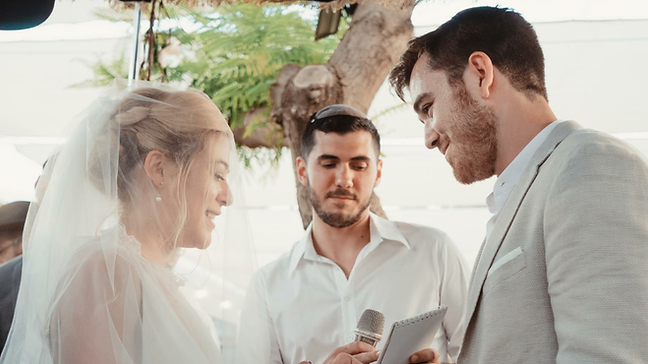
Rabbi Reichenbach officiated our backyard wedding ceremony surrounded by our family, and we couldn't have asked for a better experience. From our very first conversation, he was a pleasure to work with, and we quickly developed a genuine personal connection. He took the time to get to know us and created a ceremony that felt personal, meaningful, and reflected who we are as a couple. We are very grateful for the care and thoughtfulness he brought to our wedding.