Bezalel, in the Shadow of God
“See, the LORD has singled out Bezalel son of Uri son of Hur, of the tribe of Judah. He has endowed him with a divine spirit of skill, ability, and knowledge in every kind of craft.” — Exodus 35:30–31
The essay
In Vayakhel–Pekudei, the construction of the Mishkan begins in earnest. The Torah lingers over wood, gold, rings, and curtains, reminding us that holiness here is not abstract. It is something built.
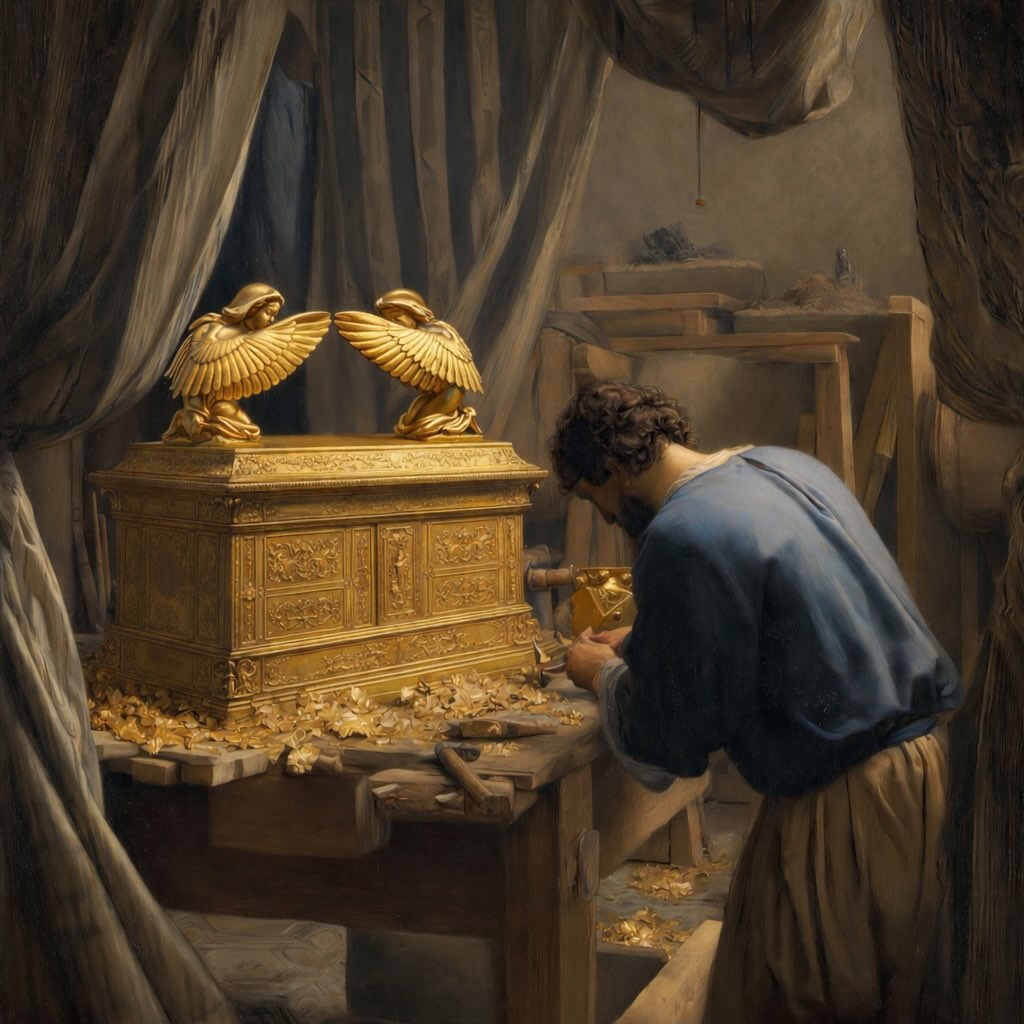
At the center stands the Ark of the Covenant, crowned by two cherubim whose wings stretch toward one another. Their meeting point marks the place where heaven and earth touch. The cherubim were to be made miksha achat, hammered from a single piece of gold (Exodus 25:18). The Talmud teaches that this command was so difficult that Moses struggled to grasp it; Midrash imagines God showing him an Ark made of fire before the work could begin.
Bezalel’s name means “in the shadow of God.” Berakhot 55a suggests that he possessed the wisdom to combine the very letters with which heaven and earth were created. Bezalel does with wood and gold what God did with light and dust.
Sacred architecture in the Torah is not the achievement of kings but the work of inspired artisans. God dwells where human beings shape the world with wisdom. Creation did not end on the seventh day. It continues wherever human hands build something worthy of the Divine presence.
Visual conversation
The composition draws inspiration from Johannes Vermeer’s The Art of Painting (c. 1666–1668), where quiet light falls on an artist at work within a curtained interior.
Learning questions
What does it mean for craft to become a spiritual practice?
Why might the Torah place sacred architecture in the hands of an artisan rather than a king?
Where do human creativity and Divine presence meet in this image?
Process note
This VisualMidrash work may use AI-assisted image-making as part of a directed artistic process. It is an interpretive image, not a documentary photograph, archaeological reconstruction, or claim about the historical appearance of biblical figures.