The Fox at the Ruins
“Because of Mount Zion, which is desolate; foxes walk upon it.” — Lamentations 5:18
The essay
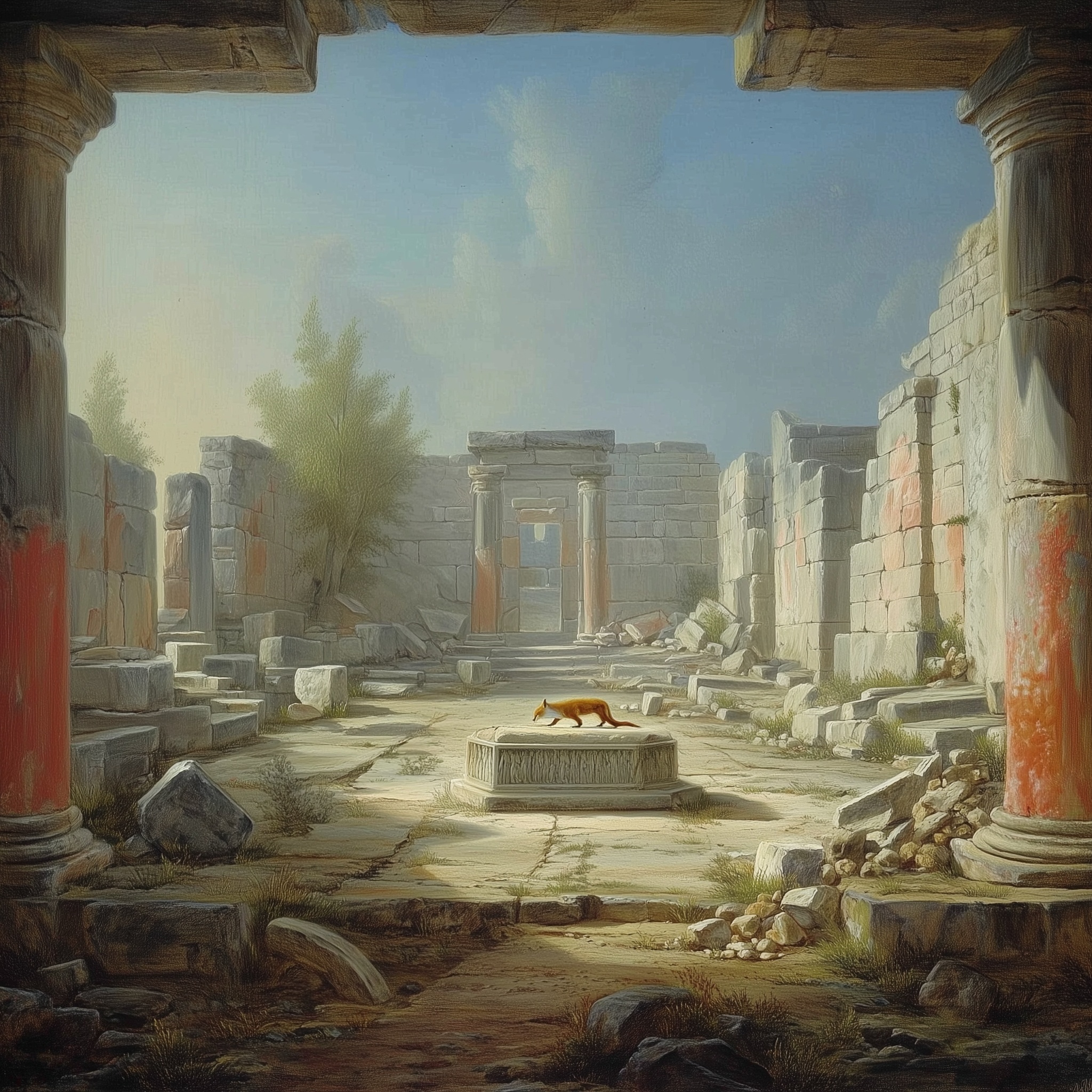
When the sages reached the ruins of Jerusalem and saw a fox emerge from the place of the Holy of Holies, the rabbis wept. Rabbi Akiva laughed.
The Talmud records their disbelief: “Akiva, why do you laugh?” (Makkot 24b). The sight before them seemed to confirm only devastation. Akiva’s answer is startling. If the prophecies of destruction have been fulfilled so exactly, then the prophecies of consolation must be equally true.
Ruin becomes evidence not of abandonment, but of continuity. The same voice that foretold collapse also promised restoration.
Chazal stress that Akiva does not deny grief. He moves through it. Avot de-Rabbi Natan presents his laughter not as cruelty, but as temporal courage: an ability to see beyond the present without erasing it.
The fox does not make the ruins less real. It becomes a small sign that destruction is real but not the final horizon.
Visual conversation
The painting draws on Hubert Robert (1733–1808), whose ruin paintings linger over broken columns and open skies. His ruins are not empty; they are transitional spaces where meaning persists.
Learning questions
What is the difference between denying grief and refusing to let grief define the future?
What can a ruined place still teach?
How can hope honor loss rather than erase it?
Process note
This VisualMidrash work may use AI-assisted image-making as part of a directed artistic process. It is an interpretive image, not a documentary photograph, archaeological reconstruction, or claim about the historical appearance of biblical figures.