The Still, Small Voice
“And after the fire—a still, thin voice.” — I Kings 19:12
The essay
Elijah does not meet God in spectacle: not in the wind, not in the earthquake, not in the fire. Only afterward. Kol demamah dakah: a sound that is almost silence.
Chazal linger on this moment. Berakhot 31a teaches that the Divine Presence does not rest amid noise or force, but only once agitation subsides. Pesikta Rabbati 26 imagines Elijah being answered here, not for sin, but for certainty. God responds not with power, but with quiet.
The phrase itself is paradoxical: kol, sound; demamah, silence; dakah, thin, fragile, small. Radak understands it as a voice barely perceptible, heard only when resistance loosens.
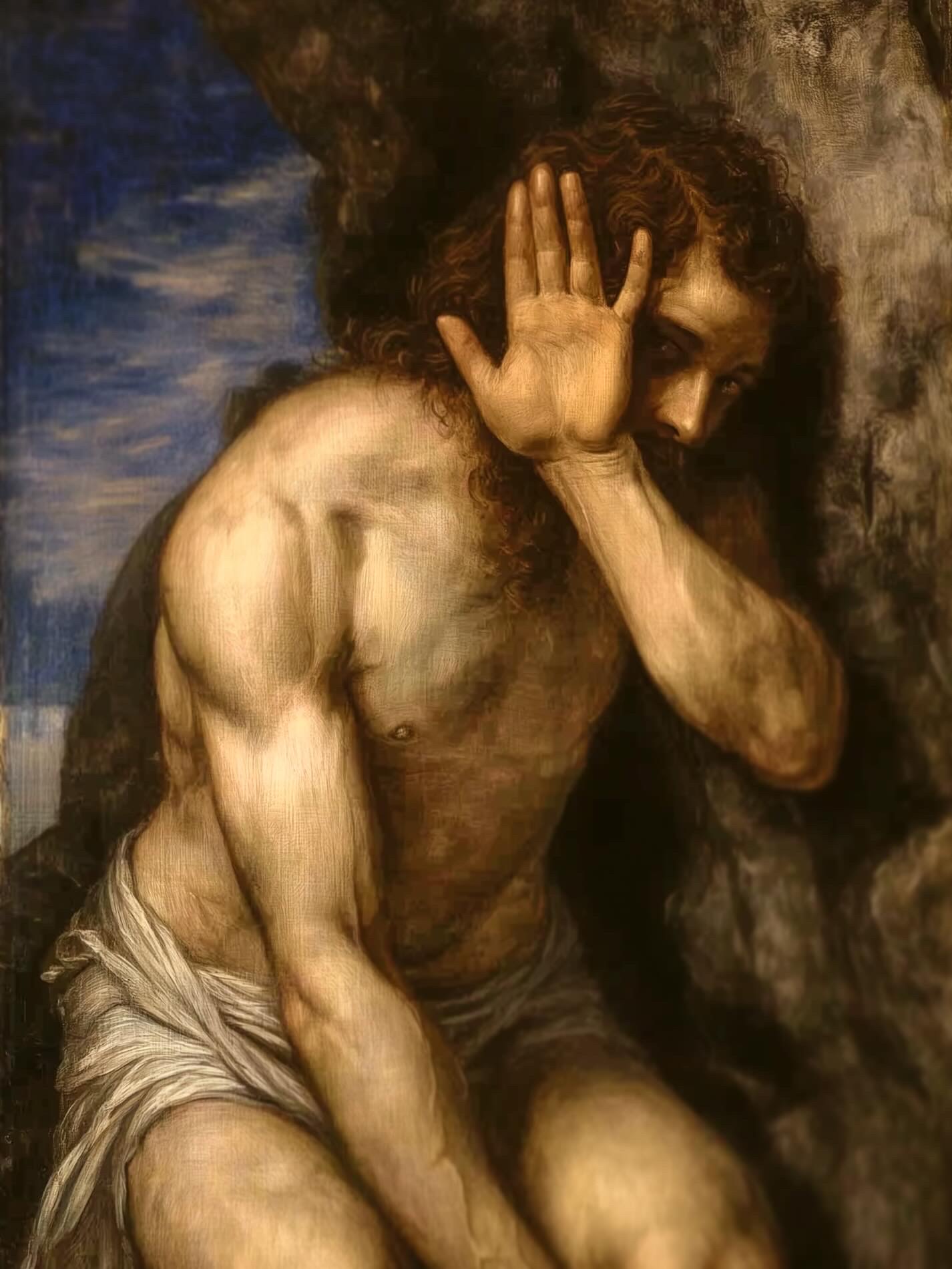
Elijah’s body still holds fear; only moments ago the world was overwhelming. But his eyes have changed. They are already calm. Already listening. The image holds the passage from pain to stillness, from fear to acceptance. Not peace yet, but the beginning of it.
The still, small voice is not heard instead of fear. It is heard as fear loosens. Revelation meets us in transition, when listening first becomes possible.
Visual conversation
The visual language draws on Titian’s Saint Sebastian from the Averoldi Altarpiece (1520–1522). Titian’s saints are marked by strain and endurance; meaning arrives through the body, not above it.
Learning questions
What does the body reveal after the spectacle has ended?
Where do you listen for revelation?
What has to quiet down before a voice can be heard?
Process note
This VisualMidrash work may use AI-assisted image-making as part of a directed artistic process. It is an interpretive image, not a documentary photograph, archaeological reconstruction, or claim about the historical appearance of biblical figures.